- Email atoglobalschool@gmail.com
- Phone +91 99999 22222
Inclusion is not simply about making space for a child. It is about making sure that every child knows there is a space for them.
Inclusion is a word we hear quite often nowadays. In schools, it is generally understood as accepting and supporting children with diverse learning needs. But inclusion is much more than that. As a leading inclusive Cambridge school, our goal is to create an environment where every child—regardless of their abilities, background, language, culture, or learning style—feels a genuine sense of belonging.
Because children learn from one another.
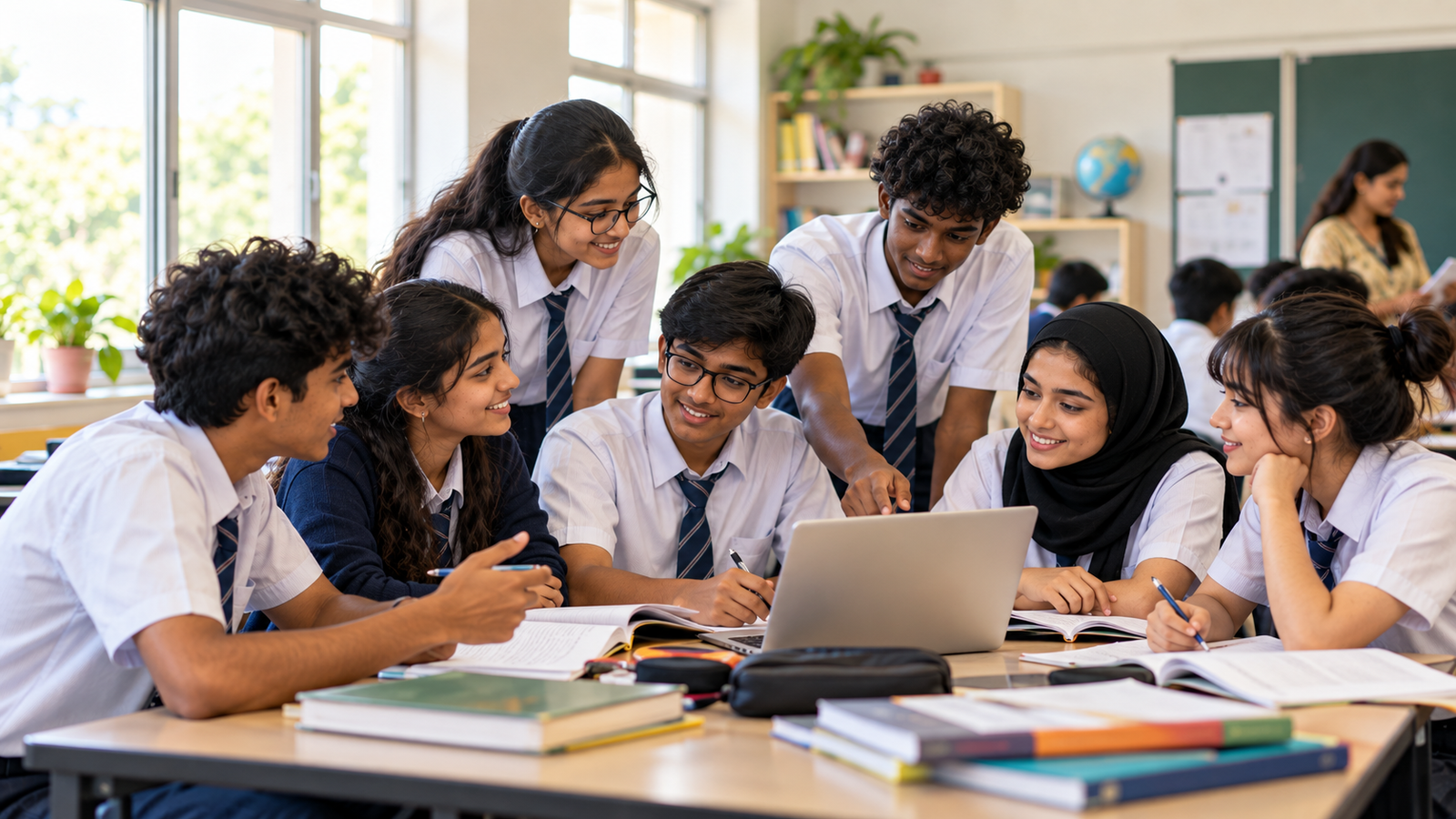
A learner who has additional learning needs may be in a class alongside a learner who is more engaged, independent, or confident. Through observation, interaction, and peer support, the child who needs additional support may develop skills that cannot always be taught through direct instruction alone.
But the learning does not happen in only one direction.
The more confident learner also learns. They discover that everyone does not learn in the same way or at the same pace. They learn to be flexible, understand another child’s perspective, and develop patience, empathy, tolerance, and responsibility.
Inclusion allows children to grow not only as learners, but also as people.
Throughout history, people and communities have learned from one another, sharing knowledge, skills, languages, traditions, and ideas. Much of human progress has come from the exchange of different experiences, knowledge, and perspectives.
The same principle guides our approach at Alpha to Omega Global School. We believe that children grow not only through what teachers teach them, but also through what they learn from one another. When children with different abilities, experiences, backgrounds, and ways of thinking learn together, each child has an opportunity to contribute as well as learn.
This is at the heart of our school philosophy: every child should have the opportunity to participate, contribute, discover their strengths, and experience success in their own way.
Difference is not something to overcome; it is an opportunity to learn, grow, and evolve.
Inclusion is not limited to children with diverse learning needs. It is also about bringing together children from different age groups, economic backgrounds, languages, cultures, and family backgrounds. It includes children with physical, social, emotional, and learning needs.
When children from different backgrounds come together, their exposure increases and their thinking expands. They learn to communicate, collaborate, understand differences, and see the world from perspectives other than their own.
A shy child may find confidence through supportive peers. A very active child may learn responsibility by helping someone else. A child who needs more time may discover that learning at a different pace does not mean being left behind.
All children have the opportunity to grow.
Inclusion does not simply mean having different children sitting together in the same classroom. It means giving each child what they need to participate meaningfully.
This means providing accommodations, differentiating instruction, adapting teaching strategies, or offering different ways for children to demonstrate what they know.
And this includes our high achievers too.
When we talk about inclusion, our attention often goes towards children who are struggling. But a child who is already performing well also needs to be included in the learning process. High achievers need opportunities to question, explore, create, take responsibility, and move beyond what they already know.
If every child matters, then every child’s potential matters.
At Alpha to Omega Global School, we try to keep this belief at the heart of what we do.
I remember a girl who joined our school at ten with very little experience of group activities. Initially, she found group activities challenging and would often resist attempts to involve her.
During our Sports Meet, she watched the other children participate, cheer for one another, and celebrate together. This seemed to spark something in her. She decided to come to the field.
She did not change overnight, but she found a reason to take that first step. It reminded me that inclusion is sometimes about giving children enough opportunities to observe, experience, and discover something that makes them want to participate.
Another boy, a high achiever, was reluctant to take part in a school drama. He needed encouragement and appreciation before agreeing to participate. We gave him the responsibility of helping a friend who needed support with attention and participation. Having a meaningful role helped him find his way into the activity.
And then there are the everyday moments that often go unnoticed: students who take up a task, help a classmate, or quietly support another learner without being asked.
These moments remind us that inclusion is not simply something adults create for children. It can become part of how children learn to notice one another, take responsibility, and make space for each other.
There is no single way into participation. Sometimes a child needs inspiration, sometimes responsibility, and sometimes simply the opportunity to discover that they have something valuable to contribute.
Inclusion does not stop at our classroom door.
At our Sports Meet, all children have opportunities to participate alongside their peers. They experience competition, teamwork, encouragement, and the satisfaction of being part of something together.
During our Annual Day, every child has an opportunity to be on the stage. Each child has a role and an opportunity to contribute.
Field trips offer another kind of learning. Children explore, discover, interact, and experience something together. They learn beyond the classroom while finding their own ways to participate.
These experiences matter because inclusion is not only about academic learning. It is about giving children opportunities to discover their strengths, develop confidence, contribute to the community, and experience success in their own way.
At Alpha to Omega Global School, we strive to include every child in our conversations, classrooms, and curriculum. We use different teaching approaches and forms of assessment, and we create opportunities for children to participate, perform, compete, contribute, and be seen.
We do not simply talk about inclusion. We live it.
We give children the space to do what they do well while encouraging them to discover what else they are capable of.
Ultimately, our goal is not simply for every child to be present. It is for every child to participate, contribute, grow, and belong.
Because inclusion is not about making space for a child.
It is about making sure that every child knows there is a space for them.
And perhaps that is where true inclusion begins.
Alpha to Omega Global school offers a holistic approach to learning. Click here to know more.
Contact us