- Email atoglobalschool@gmail.com
- Phone +91 99999 22222
Movement is the fundamental expression of life. It is the invisible thread that separates what we consider living from that of non living. Every vital process of life namely breathing, circulation, neural signaling, and even cellular respiration is a form of movement. To move is to live, and to live is to engage with the world, shaping and being shaped by it.
Yet, if we observe closely, movement does not begin in the body, it begins in stillness. Before any physical action occurs, there is an internal shift: a thought, an intention, or an impulse arising from the mind. In traditional Tai Chi and Chi Kung philosophy, this is often described as the movement of internal energy or awareness preceding external form. The body follows the mind, and the quality of movement reflects the quality of attention behind it.
In a modern world filled with constant distraction and fragmented attention, this connection between mind and movement becomes especially important. At Alpha to Omega Global School, Chennai, we believe that holistic child development begins with nurturing this very connection.
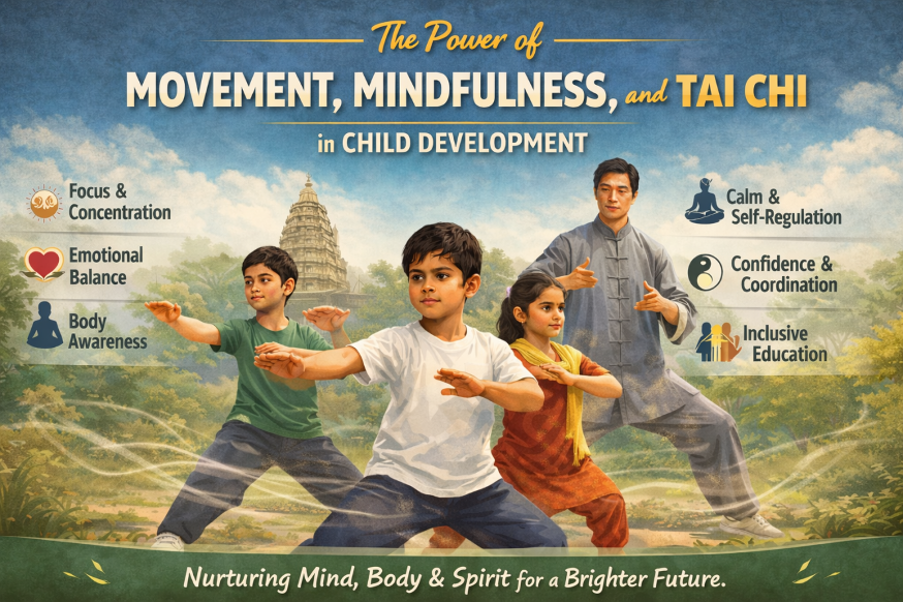
Practices like Tai Chi train the brain to sustain focus through intentional, flowing sequences. These sequences require children to remember patterns, transition smoothly between postures, and remain mentally present throughout. As a result, they strengthen working memory, sequencing ability, and sustained attention skills that are foundational for learning across all academic domains and central to our research-based learning approach.
Benefits of Tai Chi exercise
Beyond cognitive benefits, Tai Chi offers profound support for emotional development in children. Its slow, rhythmic movements paired with controlled breathing help regulate the nervous system, shifting the body from states of stress or overstimulation toward calm and balance. For children, this creates a natural pathway to emotional self-regulation. They learn, not through instruction alone but through embodied experience, how to settle their minds, manage anxiety, and return to a state of equilibrium.
This is particularly meaningful for neurodivergent children, who may experience heightened sensory input, emotional intensity, or difficulty with self-regulation. Tai Chi provides a structured yet gentle framework where repetition and predictability create a sense of safety. Within this safe structure, children can explore movement without pressure, building confidence and resilience over time. This aligns with our commitment to inclusive education and supporting children with specific learning difficulties.
Another key benefit lies in the development of proprioception, the awareness of one’s body in space. Many children, especially those with sensory processing differences, struggle with coordination and spatial awareness. Tai Chi’s emphasis on posture, alignment, and slow, deliberate shifting of weight helps refine this internal sense. As children become more aware of their bodies, they often experience improved balance, smoother coordination, and greater physical confidence.
The slow and controlled nature of Tai Chi is particularly valuable for sensory integration. Rather than overwhelming the nervous system, it provides steady, manageable input that helps children organize sensory information more effectively. For those who are hypersensitive, it offers a calming, predictable experience; for those who are hyposensitive, it provides clear and consistent feedback from the body.
At a deeper level, Tai Chi exemplifies the principle that movement and thought are not separate processes, but interconnected aspects of a unified system. This concept often referred to as embodied cognition suggests that the body plays a central role in shaping the mind. In Tai Chi practice, children coordinate breath, intention, and movement simultaneously. This integration strengthens neural pathways that connect cognitive, sensory, and motor functions, supporting overall brain development and neuroplasticity outcomes that reflect the goals of cognitive skills development at the heart of our curriculum.
Furthermore, traditional teachings emphasize efficiency and internal structure over force. Children learn to move with alignment rather than tension, to generate power through coordination rather than strain. These principles not only enhance physical ability but also cultivate patience, awareness, and discipline qualities that extend far beyond movement practice into everyday life, and that we actively foster through social-emotional learning within our inclusive classroom environment.
Ultimately, Tai Chi is more than a physical exercise; it is a method of cultivating awareness. It teaches children to listen inwardly, to recognize the subtle beginnings of movement in the mind, and to express that awareness through the body with clarity and control. In doing so, it nurtures a deeper connection between mind and body, helping children grow not only stronger and more coordinated, but also more focused, balanced, and self-aware.
Make all your movements intentional!
Alpha to Omega Global school offers a holistic approach to learning. Click here to know more.
Contact us